Mark the Date: A Modern Tool for Creative Planning and Milestone Capture
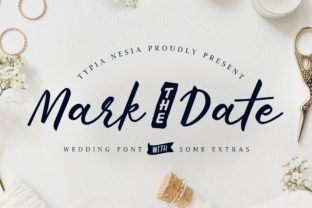
In the dynamic landscape of personal and professional projects, capturing significant moments demands more than a simple note. Mark the Date emerges as a distinct script font designed to bring elegance and intentionality to the process of highlighting important dates, deadlines, and achievements. With its unique flow and modern calligraphy style, it isn't merely a decorative element; it is a functional asset for anyone who values clarity and aesthetic appeal in their documentation and planning systems. Its charm is practical, offering a way to visually anchor key points within a broader workflow.
Integrating Mark the Date into Your Planning Ecosystem
Effective workflow management relies on a synergy of tools. Mark the Date functions as a specialized component within this ecosystem. Its primary role is to serve as a high-visibility marker, distinguishing critical dates from routine entries. Imagine your project timeline in a digital planner or a printed report: the standard dates are listed in a clean sans-serif font, but the launch date, the client presentation, or the project completion milestone is rendered in the distinctive strokes of Mark the Date. This visual hierarchy is immediate and clear.
This script interacts seamlessly with other resources. For digital creators, it can be used in graphic design software to annotate keyframes in a video production schedule or to mark publication dates on a content calendar mock-up. Bloggers and educators might integrate it into downloadable PDF planners or course milestone certificates. For professionals and entrepreneurs, embedding this font into presentation decks or strategic roadmap documents can subtly emphasize fiscal quarter ends or product release dates, guiding the audience’s focus without aggressive formatting.
A Practical Approach to Preparation and Use
Before integrating any new asset, considering compatibility and preparation is crucial. Mark the Date is a font file, meaning its usability hinges on its installation in your operating system and its availability within your chosen applications—be they Adobe Creative Suite, Microsoft Office, Canva, or even web-based design tools through CSS. Ensuring it is properly licensed and installed is the first step. Organization follows: decide on a consistent application rule. Will you use it only for final milestones? Or for both start and end dates of a major phase? Establishing this internal guideline prevents arbitrary use and maintains document consistency.
Quality control in long-term use involves resisting overuse. The strength of Mark the Date lies in its selective application. If every date is marked, the visual signal loses its power. A practical tip is to review your document or plan and ask: “Which dates are the true decision points or irreversible commitments?” Those are the candidates. For a freelance designer, this might be the contract signing date and the final delivery date. For a small business owner running a marketing campaign, it could be the campaign start date and the analysis review date.
Workflow Examples: From Concept to Execution
To understand its fit, let’s examine Mark the Date in action across different scenarios. These examples focus on the process, not just the aesthetic outcome.
In a creative process, such as writing a book or composing a music album, the workflow is often nonlinear. Using a physical or digital journal to track progress, you might mark key conceptual breakthroughs or completion dates for drafts. Writing “First Draft Completed” with Mark the Date on your progress tracker creates a celebratory and definitive record, a visual reward that punctuates the process. It interacts with your daily writing log (perhaps in a standard font) by providing a clear summary of major achievements.
For a business workflow like a product launch, the integration is more systematic. The launch plan likely lives in a shared document or project management tool. While the tool itself may not use the font, the communicated summaries and final timelines presented to stakeholders can. The “Market Launch Date” and “Post-Launch Review Date” rendered with Mark the Date in the executive summary PDF immediately signal their importance, aiding in alignment and focus. This bridges the gap between the granular task list in the management platform and the high-level communication assets.
In personal goal tracking, such as a fitness or learning challenge, Mark the Date can enhance the physical or digital chart you maintain. The date you reached a target weight or completed a certification course, marked with this script, serves as a powerful motivator when you review your progress history. It interacts with your daily check-ins by crystallizing the outcomes, transforming a log into a testament.
Enhancing Efficiency and Long-Term Value
The efficiency gain from using Mark the Date is not about speed, but about clarity and reduced cognitive load. In a dense project plan, a team member can instantly locate the most critical deadlines without scanning every line. This supports efficient review meetings and decision-making. For long-term use, such as in quarterly business reports archived over years, the consistent use of this font to mark fiscal period endings creates a recognizable pattern. Anyone reviewing an old report quickly understands the structural milestones, aiding in historical analysis and forecasting.
Consistency is key for this long-term value. Apply it to similar types of milestones across projects. If you use it for “Client Approval Date” in one project, use it for the same type of sign-off in another. This builds an intuitive visual language within your personal or organizational documentation.
Adapting Mark the Date to Your Unique Routine
Integration should be smooth and natural, not forced. Start by identifying one current process where date distinction is problematic or visually flat. Perhaps your monthly newsletter planning template in Google Docs has all dates in the same style. Introduce Mark the Date solely for the “Final Send Date.” Observe if this makes your internal communication about deadlines quicker or clearer.
For those heavily reliant on digital platforms with limited font support, consider a hybrid approach. Use Mark the Date in the final exported or printed versions of your plans, even if the working version within the platform uses a default font. This separates the execution environment from the presentation environment, a common practice in many fields.
Remember, the tool serves the process. If your workflow is highly collaborative and uses shared software that doesn’t support custom fonts, the application of Mark the Date might be confined to your personal summaries or leadership reports. Its use is still valuable for your own clarity and for when you need to distill complex timelines for others.
Balancing Modern Charm with Functional Utility
The calligraphy style of Mark the Date offers a modern charm that breaks the monotony of utilitarian documents. This isn't frivolous; in a world saturated with minimalist, stark interfaces, a touch of elegant distinction can improve engagement with the material. A marketing manager reviewing a campaign timeline is more likely to dwell on a beautifully marked key date, absorbing its significance. This subtle psychological effect supports deeper processing of important information.
However, the utility must always lead. The flow of the script must not compromise legibility. In implementation, always test the rendered date in context. Is it clear at the size you will use? Does it stand out without confusing the reader? This quality control step ensures the font enhances, rather than hinders, the communication purpose.
Ultimately, Mark the Date is a bridge between rigorous planning and human-centric design. It acknowledges that the milestones in our projects, creative endeavors, and personal goals are not just data points; they are moments of significance. By giving them a distinct visual form, we integrate a layer of intentional recognition into our workflows, making our plans not only functional but also reflectively meaningful. Its integration, therefore, becomes a small but deliberate step in crafting processes that respect both efficiency and the human elements of achievement and progress.